



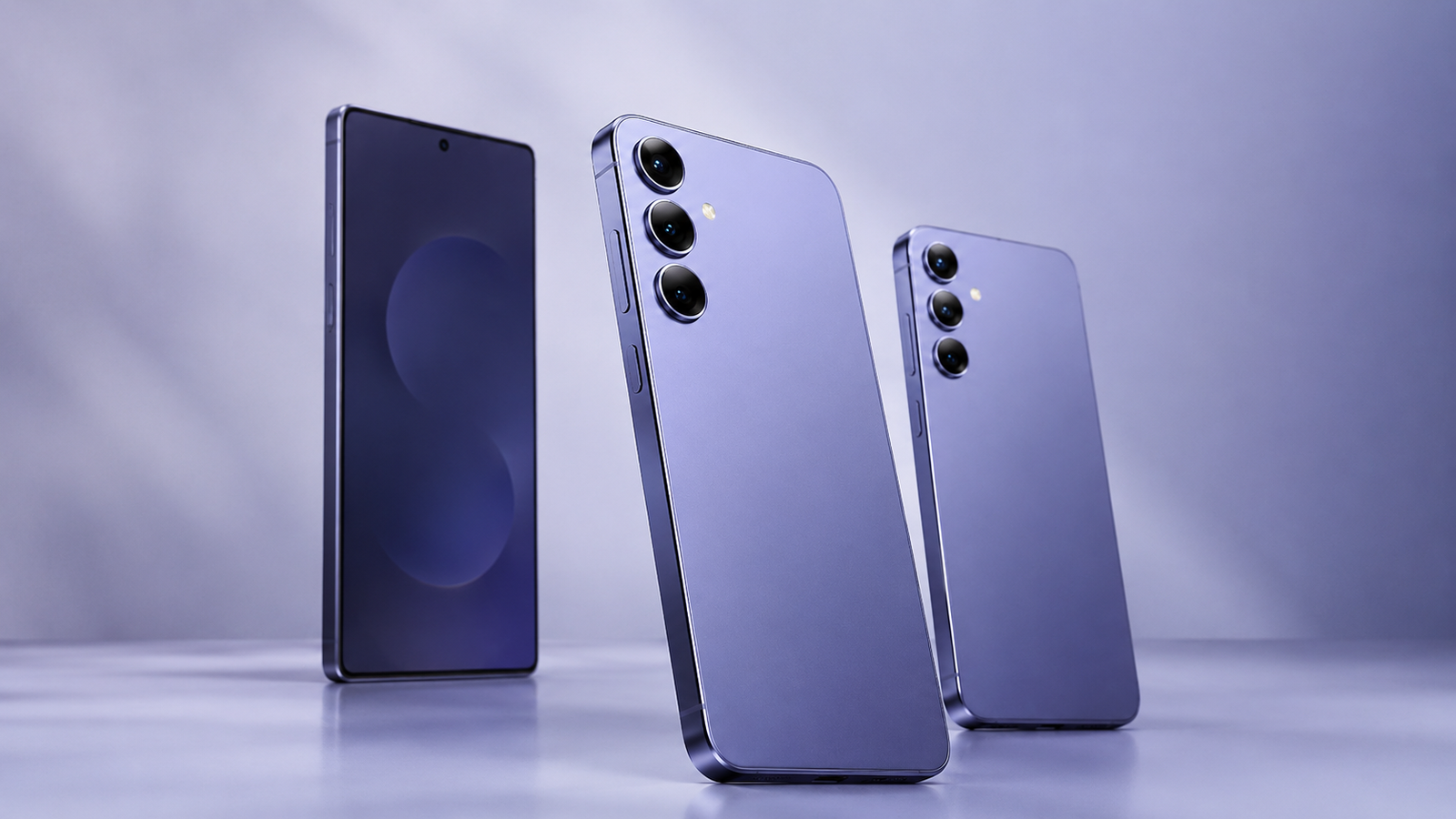
Samsung presented the Samsung Galaxy S26 series on February 25, 2026, before releasing the phones globally on March 11. The range includes the compact Galaxy S26, the larger S26+ and the camera-focused S26 Ultra.
Several months after launch, the bigger story is no longer simply the specification sheet. The S26 shows where premium smartphones are moving: more proactive AI, longer software support, higher base storage and greater dependence on software to improve familiar camera hardware.
That does not make every S26 model an essential upgrade. The base phone is faster, slightly larger and more intelligent than its predecessor, but independent testing suggests that its camera and battery improvements are less dramatic than Samsung’s marketing may imply.
Quick Answer
The Samsung Galaxy S26 is a compact flagship built around faster performance, 12GB of RAM, at least 256GB of storage and more proactive Galaxy AI features.
Its most meaningful improvements are the larger 6.3-inch display, 4,300mAh battery, faster processor, stronger cooling and longer software runway. However, the base S26 retains a camera system that is very similar to the Galaxy S25.
Galaxy S25 owners can generally wait. People upgrading from an S22, S21 or an older mid-range Android phone will notice a much larger difference. Buyers seeking Samsung’s biggest hardware changes should consider the S26 Ultra instead.
What Changed With the Samsung Galaxy S26?
Samsung has not completely redesigned its standard flagship. Instead, it has improved several parts of the experience while making Galaxy AI more deeply connected to everyday phone activity.
The base Galaxy S26 now has a 6.3-inch Dynamic AMOLED 2X display, up from the S25’s 6.2-inch screen. It includes 12GB of memory, either 256GB or 512GB of storage and a 4,300mAh battery. The S26+ retains a 6.7-inch display and uses a larger 4,900mAh battery.
Samsung also introduced a unified camera-island design, a front-camera AI image processor and Horizon Lock video stabilization. Horizon Lock is designed to keep footage level while the phone rotates or moves, although available resolution and results can depend on the selected recording mode and conditions.
Samsung Galaxy S26 specifications at a glance
| Specification | Galaxy S26 | Galaxy S26+ | Galaxy S26 Ultra |
|---|---|---|---|
| Display | 6.3-inch FHD+ AMOLED | 6.7-inch QHD+ AMOLED | 6.9-inch QHD+ AMOLED |
| Refresh rate | 1–120Hz | 1–120Hz | 1–120Hz |
| Memory | 12GB | 12GB | 12GB or 16GB |
| Storage | 256GB or 512GB | 256GB or 512GB | 256GB, 512GB or 1TB |
| Main camera | 50MP | 50MP | 200MP |
| Telephoto | 10MP, 3x optical | 10MP, 3x optical | 10MP 3x and 50MP 5x |
| Battery | 4,300mAh | 4,900mAh | 5,000mAh |
| Wired charging | 25W | 45W | 60W |
| Launch software | Android 16, One UI 8.5 | Android 16, One UI 8.5 | Android 16, One UI 8.5 |
| Water resistance | IP68 | IP68 | IP68 |
Samsung states that processor selection for the S26 and S26+ can differ by device and market, with Snapdragon 8 Elite Gen 5 for Galaxy and Exynos 2600 configurations listed in its global specifications. The Ultra uses the customised Snapdragon platform. Buyers should therefore confirm the processor included with their country-specific model rather than relying on specifications from another region.
Why the Galaxy S26 Matters Now
The Galaxy S26 is important because it reflects three wider smartphone trends appearing across 2026.
AI is moving from commands to suggestions
Earlier AI phone features usually required the user to open a tool and request a specific action. Samsung is now attempting to make AI more proactive.
Now Nudge can identify context from messages, images and supported apps before suggesting a relevant action. Now Brief can surface travel information, reservations, reminders and other personal updates. Samsung also supports multiple assistants, including Bixby, Gemini and Perplexity, although functions vary by country, language, app and account configuration.
This is what Samsung means by an “agentic” phone: a device that can recognise intent, connect information and reduce the number of manual steps required to complete a task.
The important limitation is that this experience is not universal. Some features need a Samsung account, network access, notification permissions or access to services such as Gmail. Samsung also states that AI-generated results may be inaccurate or unreliable.
Hardware privacy is becoming a premium feature
The S26 Ultra introduces a built-in Privacy Display that limits visibility from side angles when activated. Users can enable it across the full display or apply it to selected information, such as password entry fields and notification pop-ups.
Unlike a permanent privacy screen protector, the feature is integrated into the display and can be turned off when wide viewing angles are preferred.
It is not absolute protection. Samsung warns that information may remain visible depending on the viewing angle, brightness and environment. Privacy Display should therefore be treated as an additional privacy layer, not a replacement for careful handling of sensitive information.
Premium phones are becoming more expensive
The standard Galaxy S26 launched at $899.99 in the United States, while the S26+ started at $1,099.99. Both represented higher entry prices than their direct predecessors, although Samsung also doubled the minimum storage to 256GB.
Samsung executives linked the higher pricing partly to rising component and memory costs. This makes the S26 part of a broader 2026 technology trend in which demand for AI infrastructure is influencing the price and availability of memory used in consumer electronics.
Evidence Behind the Galaxy S26 Trend
| Signal | What it shows | Important limitation |
|---|---|---|
| Global release on March 11, 2026 | The full S26 range is commercially available | Configurations differ by market |
| Minimum 256GB storage and 12GB RAM | Flagship baseline specifications are rising | Entry prices have also increased |
| Now Nudge, Now Brief and multiple AI agents | Samsung is moving toward proactive mobile AI | App, language and regional support vary |
| Privacy Display on the Ultra | Hardware privacy is becoming a product differentiator | It is not available on the S26 or S26+ |
| One UI 9 beta launched for S26 devices | The phones remain central to Samsung’s software development | Beta software is not suitable for every user |
| Company-reported preorder growth | Strong early interest, especially in the Ultra | Figures were reported by Samsung rather than an independent analyst |
Samsung reported double-digit preorder growth for the series and said the Ultra accounted for more than 70% of Galaxy S26 preorder selections worldwide. These company-reported figures suggest that buyers were more interested in the model with visible hardware changes than in the comparatively iterative S26 and S26+.
Galaxy AI Is the Main S26 Upgrade
The standard Galaxy S26 camera hardware has not changed dramatically, so Samsung is relying heavily on AI and computational processing to create a noticeably different experience.
Now Nudge
Now Nudge examines supported on-screen or message context and recommends an action. A message about a meeting could prompt a calendar check, while a request for holiday photographs could generate a relevant Gallery suggestion.
Its usefulness will depend on how frequently accurate suggestions appear and how comfortable users are granting the permissions needed for contextual analysis.
Photo Assist
Photo Assist accepts natural-language editing requests. Users can remove objects, restore missing portions of an image, change elements or generate additions without moving the photograph to a separate desktop editor.
Samsung places a visible watermark on saved AI-generated results and warns that output accuracy is not guaranteed. Some functions also require a network connection and Samsung account.
Creative Studio
Creative Studio combines prompts, photographs and sketches to produce items such as wallpapers, stickers and invitations. It is aimed more at quick personal creation than professional design production.
The feature provides a convenient starting point, but it should not be considered a complete replacement for professional image-editing or design software.
Upgraded Bixby and third-party agents
Bixby can understand more natural requests related to device settings and supported apps. The series also integrates Gemini and Perplexity, allowing users to choose between assistants for different tasks.
This multi-agent approach may become one of the S26’s most significant long-term developments. Instead of forcing every request through a single assistant, Samsung is positioning the phone as a platform where different agents can perform different jobs.
Samsung Galaxy S26 vs S25: Is the Upgrade Big Enough?
For most Galaxy S25 owners, no.
The S26 has a slightly larger display, a 300mAh increase in battery capacity, newer processors, 12GB of RAM across configurations and one additional year of future software eligibility. It also introduces newer Galaxy AI functions and video tools.
However, the standard S26 continues to use a 50MP main camera, 12MP ultrawide camera and 10MP 3x telephoto camera. Independent comparisons found that its photographs were often similar to those captured by the S25, with limited differences in detail and colour.
The larger battery does not automatically guarantee longer real-world endurance either. Tom’s Guide recorded 11 hours and 28 minutes in its S26 battery test, below the result recorded for the S25. The publication also noted that its testing method had changed, preventing a completely direct comparison.
A practical upgrade guide
| Your current phone | Recommended decision |
|---|---|
| Galaxy S25 | Keep it unless a specific AI feature is essential |
| Galaxy S24 | Upgrade only for a strong discount, more storage or better trade-in value |
| Galaxy S23 | Consider upgrading if battery health or storage is becoming limiting |
| Galaxy S22 or older | The S26 should feel like a substantial overall upgrade |
| Older mid-range Android | Upgrade for stronger performance, cameras, display quality and support |
| Recent iPhone | Switch only when Android flexibility or the Galaxy ecosystem is the priority |
Hype vs Reality
| Claim | Reality |
|---|---|
| “The S26 is a completely new Galaxy phone” | Its design, performance and AI have advanced, but the standard model remains an iterative hardware update. |
| “Agentic AI will operate the entire phone for you” | It can reduce steps in supported situations, but availability, accuracy and app integration remain limited. |
| “The bigger battery guarantees better battery life” | Capacity increased, but independent results show that software, processor behaviour and testing conditions also matter. |
| “The camera is significantly better” | The base and Plus camera hardware is familiar. The Ultra receives more meaningful low-light hardware upgrades. |
| “Privacy Display makes the Ultra completely private” | It reduces side-angle visibility but cannot guarantee that no information will be visible. |
| “Every S26 has the same processor” | Samsung states that the S26 and S26+ processor can vary by market and device. |
| “All Galaxy AI features will always remain free” | Samsung says its basic AI features are free, but future enhanced features or services may be offered under different paid terms. |
Which Samsung Galaxy S26 Model Should You Buy?
Choose the Galaxy S26 for compact flagship performance
The standard S26 is the best fit for someone who wants a relatively small Android flagship without accepting mid-range performance.
At 167 grams with a 6.3-inch display, it is easier to carry than most premium phones. It also receives the same core Galaxy AI suite as the other S26 models.
Its main weaknesses are 25W wired charging, familiar camera hardware and a higher launch price.
Choose the Galaxy S26+ for a larger screen and battery
The S26+ offers a 6.7-inch QHD+ display, 4,900mAh battery and 45W charging.
It is the sensible middle option for buyers who want more screen space and battery capacity but do not need an S Pen, 200MP camera or Privacy Display.
The challenge is value. Its price moves close enough to the Ultra that discounts and trade-in offers can determine which model makes more sense.
Choose the Galaxy S26 Ultra for the real hardware upgrades
The Ultra receives Samsung’s built-in Privacy Display, 200MP main camera, dual telephoto system, wider camera apertures, integrated S Pen and 60W charging. It also includes the Snapdragon 8 Elite Gen 5 for Galaxy across the published global specification.
It is the best option for mobile photography, zoom, handwritten input, demanding games and users who regularly view sensitive information in public.
It is also the largest and most expensive model. People who will not use the S Pen, advanced cameras or Privacy Display may receive better value from the S26 or S26+.
Samsung Galaxy S26 Price in the USA, UK, Canada and Australia
The following figures are launch prices for 256GB models. Current retail prices, trade-in credits and carrier offers can change frequently.
| Market | Galaxy S26 launch price | Availability note |
|---|---|---|
| United States | US$899.99 | Released March 11, 2026 |
| United Kingdom | £879 | Released March 11, 2026 |
| Canada | C$1,249.99 | Released March 11, 2026 |
| Australia | A$1,549 | Released March 11, 2026 |
The US and UK launch prices were published by Samsung. Canadian pricing was reported by MobileSyrup, while Samsung Australia’s comparison guide lists the A$1,549 launch price for the 256GB S26. Recheck all four regional stores immediately before publishing because temporary discounts can make the live price substantially lower than the launch price.
Country differences extend beyond currency. Processor configurations, eSIM support, carrier bands, colours, trade-in values and AI functions may vary. Importing a cheaper device from another country can create warranty, network and feature-availability complications.
How the S26 Affects Different Users
General users
The most noticeable improvements are likely to be the brighter display, fast performance, increased base storage and AI-assisted organisation.
People who mainly browse, message, stream and take casual photographs may not see enough difference to justify replacing a recent flagship.
Creators
Horizon Lock, natural-language Photo Assist and faster processing make the series more useful for social video and rapid content production.
The Ultra is considerably more relevant to serious creators because it adds wider camera apertures, stronger zoom and APV video support for higher-quality editing workflows.
Business users
Seven years of security updates, contextual assistance, call screening and Samsung Knox give the S26 a strong business case.
Businesses should still review how AI functions process company information, what permissions they require and whether specific features comply with internal data-handling policies.
Mobile gamers
The newer processors and redesigned vapour chambers support stronger sustained performance. Samsung says the S26 and S26+ cooling system improves thermal performance by 29%, while independent testing found the base S26 delivered high gaming performance.
The larger S26+ may be the better gaming choice for screen size and battery capacity, while the Ultra offers the strongest cooling and most capable hardware at a higher price.
What Most Galaxy S26 Articles Miss
The Galaxy S26 is not primarily a story about a new camera sensor or dramatic physical redesign. It is a test of whether buyers will value an evolving software platform as much as visible hardware improvements.
Samsung is making the phone more dependent on contextual information. Now Brief, Now Nudge, call screening and multi-app agents become more useful when the device can interpret messages, notifications, photographs, schedules and behaviour.
That creates a trade-off. More context can produce more useful automation, but it also makes permission controls, on-device processing, account security and transparent data policies more important.
Samsung says its Personal Data Engine supports personalised AI while Knox Enhanced Encrypted Protection separates and encrypts application data. Knox Vault provides an additional hardware-based security layer. These protections are meaningful, but users should still review individual permissions rather than enabling every AI integration automatically.
What Happens Next for the Galaxy S26?
One UI 9 will be an important test
Samsung launched the One UI 9 beta for the S26 series in May 2026. Based on Android 17, the beta introduced Quick Panel customisation, accessibility improvements, creative tools and stronger warnings against high-risk applications. Initial beta access included the United States and United Kingdom, but not every target market.
Readers should watch for the stable release date, supported countries and whether its advanced AI features reach all three S26 models.
AI availability needs to become more consistent
Samsung repeatedly notes that Galaxy AI availability differs by country, language, device, carrier and application.
The S26’s long-term value will depend less on the number of AI features announced and more on how reliably those features work across common messaging, calendar, productivity and travel apps.
Samsung may test paid AI services
Samsung’s Canadian product information states that basic Galaxy AI features are free but leaves open the possibility of paid enhanced features or new services in future releases.
Buyers should distinguish between the functions included with the phone today and any future subscription-based additions.
Privacy Display could expand beyond the Ultra
Samsung has not confirmed that Privacy Display will come to cheaper Galaxy models. Its inclusion on the Ultra nevertheless gives Samsung a distinctive hardware feature that competitors may attempt to replicate.
Future adoption will depend on cost, user demand, image-quality compromises and whether the technology proves comfortable during prolonged everyday use.
Discounts may matter more than launch prices
The standard S26 is harder to recommend at full launch price because its camera system remains familiar and cheaper S25 stock may still be available.
At a meaningful discount, however, the faster processor, increased storage, longer support runway and compact design make the S26 much more competitive.
Frequently Asked Questions
When was the Samsung Galaxy S26 released?
Samsung announced the Galaxy S26 series on February 25, 2026. General availability began on March 11, 2026.
How much does the Samsung Galaxy S26 cost?
The 256GB Galaxy S26 launched at US$899.99, £879, C$1,249.99 and A$1,549. Current prices may be lower because of promotions, carrier contracts or trade-in offers.
Is the Galaxy S26 better than the Galaxy S25?
Yes, but not in every area. The S26 has a larger display, bigger battery, faster processor, more RAM and newer AI features. Its standard camera hardware remains very similar to the S25.
Should Galaxy S25 owners upgrade to the S26?
Most S25 owners should wait unless they receive an unusually strong trade-in offer or specifically need the new AI and video features. The everyday hardware difference is relatively small.
Does the Samsung Galaxy S26 have a better camera?
The base S26 uses a familiar 50MP, 12MP and 10MP rear-camera combination. Software and video processing have improved, but the Ultra receives the more meaningful camera hardware upgrades.
Does every Galaxy S26 use Snapdragon?
No. Samsung lists Snapdragon and Exynos processors for the S26 and S26+, noting that the processor varies by device and market. Verify the regional model before purchasing.
Does the Galaxy S26 include a charger?
Samsung supplies a USB cable but not a power adapter with the S26 or S26+. A compatible charger must be purchased separately if the buyer does not already own one.
Will Galaxy AI remain free?
Samsung says its basic Galaxy AI features are free. It also states that future enhanced functions or new services may be offered under different, potentially paid terms.
Final Takeaway
The Samsung Galaxy S26 is a refined compact flagship rather than a complete hardware reset.
Its faster processor, 12GB of RAM, 256GB minimum storage, larger display and proactive AI features make it a strong upgrade from an older Galaxy phone. The seven-year security commitment also supports longer ownership.
The argument is weaker for Galaxy S25 owners. Camera hardware remains familiar, battery results are not an unquestionable leap and the launch price increased.
The S26 Ultra is where Samsung placed its clearest hardware innovation. The standard S26 is where the company is testing a different idea: that smarter, context-aware software can become the main reason to buy a new phone.
For most readers, the decision is simple. Upgrade from an older phone when the S26’s size, storage and long support period solve a real need. Otherwise, keep a recent device and watch how Galaxy AI, One UI 9 and pricing develop during the rest of 2026.
