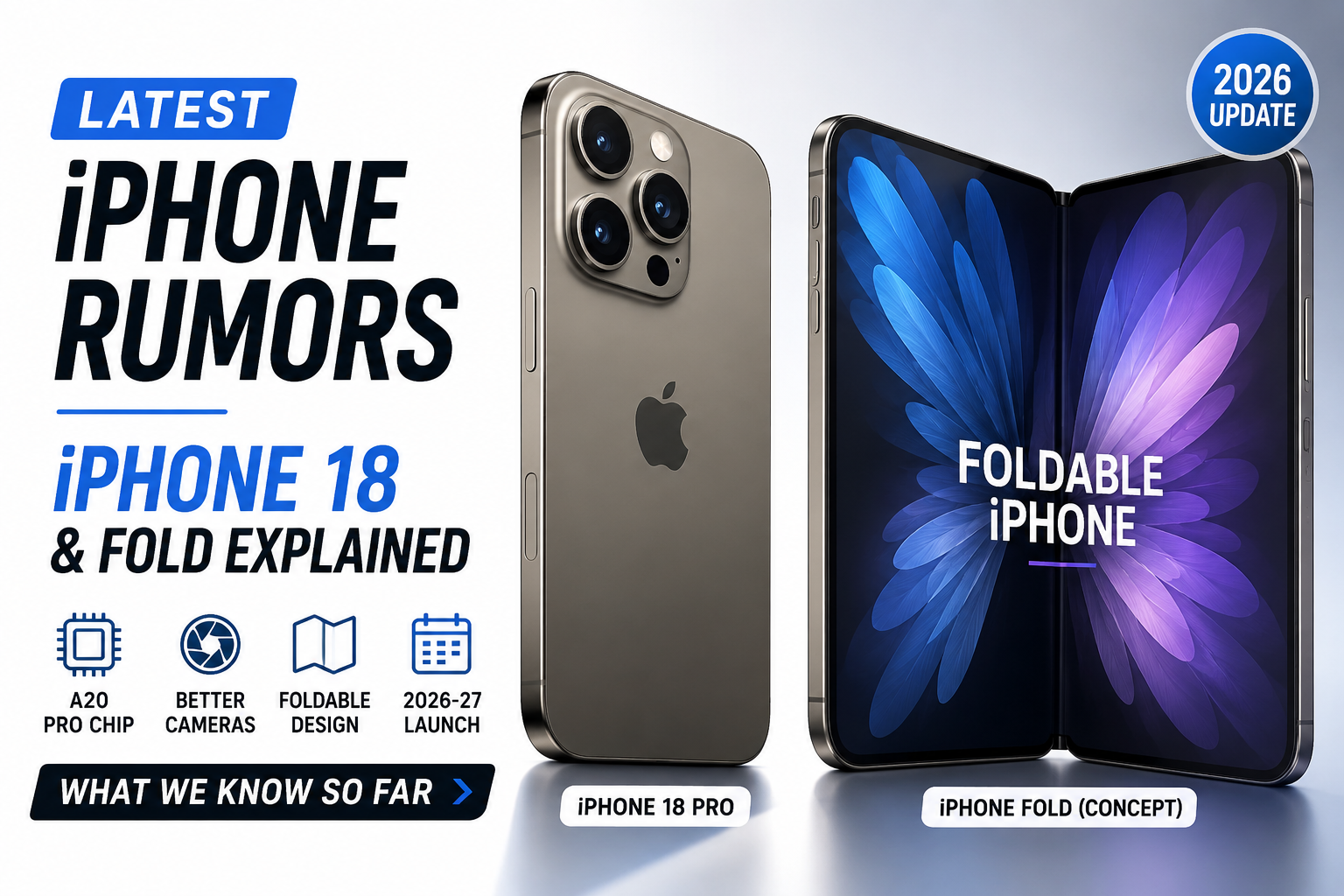
Apple’s next iPhone cycle may be less predictable than usual. The latest iPhone rumors suggest that Apple could separate its premium and standard launches, introduce its first foldable phone and give the iPhone 18 Pro meaningful camera, chip and connectivity upgrades.
Not every circulating claim deserves equal attention. Apple has not announced the iPhone 18, iPhone 18 Pro or a foldable iPhone. This analysis separates reports supported by multiple reputable sources from early leaks, conflicting claims and concept-driven speculation.
Quick Answer
The most credible reports indicate that Apple may introduce the iPhone 18 Pro, iPhone 18 Pro Max and its first foldable iPhone in fall 2026. The standard iPhone 18 and less expensive models could follow in the first half of 2027.
Expected Pro upgrades include a new A20 Pro processor, camera improvements and possible battery or connectivity changes. The foldable phone is reportedly a book-style device rather than a compact flip phone. None of these hardware details is official yet. (Reuters)
What Changed in the Latest iPhone Rumors?
The biggest story is no longer one individual specification. It is Apple’s possible restructuring of the entire iPhone release calendar.
For years, Apple has introduced its main iPhone family together in September. Supply-chain reporting now suggests that the company may prioritize three expensive models in fall 2026: the iPhone 18 Pro, iPhone 18 Pro Max and a foldable iPhone. The regular iPhone 18 may not arrive until the first half of 2027. (Reuters)
That would give Apple more room to promote its first foldable product without surrounding it with several cheaper phones. It could also reduce production pressure during a complicated hardware transition.
Rumor Evidence and Confidence
| Reported change | Editorial confidence | What supports it |
| iPhone 18 Pro models launch in fall 2026 | High | Multiple reports agree, although Apple has not confirmed an event. (MacRumors) |
| Standard iPhone 18 moves to 2027 | Medium to high | Reuters reported that Apple is prioritizing premium models and delaying the standard model. (Reuters) |
| First foldable iPhone launches in 2026 | Medium | Reuters, The Verge and other outlets report active development, but shipment timing remains uncertain. (Reuters) |
| A20 Pro uses a new 2-nanometre process | Medium | Repeated supply-chain reporting points to a new chip generation, but specifications are unofficial. (MacRumors) |
| Variable-aperture Pro camera | Medium | The feature has appeared in several analyst and component-supply reports. (AppleInsider) |
| Under-display Face ID | Low to medium | The feature has credible reporting behind it, but later leaks have questioned whether it will be ready. (MacRumors) |
| Major price increase | Medium | Rising component costs and recent Apple pricing decisions support the possibility, but country prices remain unconfirmed. (The Wall Street Journal) |
These confidence levels are editorial assessments. They are not confirmations from Apple.
The Rumored iPhone 18 Release Schedule
The expected schedule now looks more complicated than a normal annual iPhone launch.
Fall 2026
Current reporting points to three premium devices:
- iPhone 18 Pro
- iPhone 18 Pro Max
- Apple’s first foldable iPhone, informally called iPhone Fold or iPhone Ultra
The foldable product’s retail availability is less certain than its announcement. Reuters reported that engineering-test problems could delay production or shipments, while Bloomberg reporting cited by The Verge said the device remained on track for a September introduction. Both claims can be true if Apple announces the phone in September but ships it later or in limited quantities. (Reuters)
First Half of 2027
The second launch group could include:
- iPhone 18
- iPhone 18e
- A revised iPhone Air
Reuters reported that the standard iPhone 18 could be delayed until the first half of 2027 as Apple concentrates manufacturing resources on premium products. Reports about the next iPhone Air have changed repeatedly, so its inclusion remains less certain. (Reuters)
Why Apple Might Split the Launch
A split release could help Apple:
- Focus fall marketing on expensive devices.
- Manage the production risks of a first-generation foldable.
- Avoid introducing too many closely positioned phones simultaneously.
- Create a second major iPhone sales period during the spring.
- Reduce pressure on components affected by cost or supply constraints.
These are reasonable interpretations of reported production plans, not reasons officially provided by Apple. (Reuters)
iPhone 18 Pro Rumors: The Upgrades That Look Most Credible
A20 Pro Chip and Efficiency Improvements
The iPhone 18 Pro is widely expected to use an A20 Pro processor. Reports suggest it may be manufactured using a 2-nanometre process, compared with the 3-nanometre technology associated with recent Apple chips.
A smaller manufacturing process can improve performance, energy efficiency or both, but it does not automatically guarantee dramatic real-world speed gains. Apple may use part of the efficiency improvement to support more demanding on-device AI features, longer sustained performance or better battery life. (MacRumors)
The current iPhone 17 Pro uses Apple’s A19 Pro chip, vapor-chamber cooling and an aluminium unibody intended to manage sustained performance. That gives Apple a stronger thermal foundation for the next chip rather than forcing the iPhone 18 Pro to solve every performance problem through silicon alone. (Apple)
Variable-Aperture Main Camera
One of the more interesting iPhone 18 Pro camera rumors concerns a variable aperture.
An aperture controls how much light reaches the camera sensor. A variable system could let the camera use a wider opening in darker conditions and a narrower opening when greater depth of field is useful.
This would not necessarily transform every photo. Smartphone cameras still depend heavily on sensor size, lens quality and computational processing. However, it could give Apple more physical control over exposure and depth instead of relying entirely on software simulation. Component-related reporting has repeatedly connected this feature with the iPhone 18 Pro generation. (AppleInsider)
Under-Display Face ID and a Smaller Cutout
Earlier reports claimed that Apple could place parts of the Face ID system beneath the iPhone 18 Pro display, leaving only a small opening for the front camera. That could reduce the visible Dynamic Island area.
This remains one of the least settled major rumors. Display technology must preserve reliable facial authentication, camera quality and screen consistency. A feature can appear in testing without being approved for mass production. Readers should treat leaked screen layouts and precise cutout measurements cautiously until stronger evidence emerges. (MacRumors)
A Thicker Body and Larger Battery
Recent leaks have suggested that the iPhone 18 Pro models may become thicker, potentially to create more room for the battery or camera hardware. One widely repeated claim suggests an increase of roughly 2 millimetres, but it comes from a leak rather than regulatory specifications or Apple documentation. (9to5Mac)
For comparison, Apple lists both current iPhone 17 Pro models at 8.75 millimetres thick. The iPhone 17 Pro weighs 206 grams in the United States specification, while the Pro Max weighs 233 grams. (Apple)
A full 2-millimetre increase would therefore be noticeable. It is possible that leaked measurements relate to prototypes, camera areas or protective dummy units rather than the final body.
C2 Modem and Expanded Satellite Connectivity
Apple is also rumored to be developing a next-generation C2 cellular modem for the iPhone 18 Pro. Some reports claim it could improve millimetre-wave 5G support and expand satellite connectivity beyond existing emergency-oriented functions. (MacRumors)
This claim needs especially careful wording. Hardware support does not guarantee that every satellite service will work in every country. Carrier agreements, spectrum rules, satellite partners and local regulation can affect availability in the United States, United Kingdom, Canada and Australia.
The Foldable iPhone: What the Strongest Reports Suggest
Apple’s first foldable iPhone appears to be the most important and least predictable device in the rumored lineup.
Book-Style Design
The strongest reports describe a book-style phone that opens into a small tablet. That would make it closer to Samsung’s Galaxy Z Fold family than to a compact clamshell phone.
The Information’s reporting, summarized by The Verge, described an outer display of approximately 5.7 inches and an internal screen just under 8 inches. Other reports have provided slightly different measurements, which indicates that dimensions may still have been changing during development. (The Verge)
Wider Inner Display and Multitasking
Bloomberg reporting cited by The Verge suggests that the inner screen could use a relatively wide aspect ratio and support side-by-side app layouts. Apple may update its own applications and provide developers with tools to make iPhone apps adapt more effectively to the larger display.
The same report said the phone would remain an iPhone rather than running the complete iPad application catalogue. That distinction matters. A large folding display does not automatically turn the product into a replacement for an iPad mini. (The Verge)
Touch ID Instead of Face ID
Space limitations could reportedly lead Apple to use Touch ID in a side button rather than Face ID. A hole-punch front camera and two rear cameras have also been reported.
These design choices would show the compromises involved in making two thin halves fold together. Apple may prioritize thickness, hinge reliability and battery space over reproducing every iPhone Pro feature. (The Verge)
Price Could Be the Biggest Barrier
Reports have placed the expected foldable price anywhere from around $2,000 to roughly $2,500 in the United States. Those estimates are not official and should not be converted directly into UK, Canadian or Australian prices.
Local prices include different taxes, currency conditions and regional pricing decisions. Current reporting nevertheless points to a product positioned above the iPhone Pro Max rather than as a mainstream replacement for the regular iPhone. (The Verge)
Hype vs Reality
Hype: The Foldable Will Replace the Normal iPhone
A first-generation foldable is more likely to be a premium experiment than a mass-market replacement. Its reported price, manufacturing complexity and possible limited supply would restrict adoption.
Foldables also remain a relatively small part of the overall smartphone market despite years of development by other manufacturers. Reuters previously cited analyst estimates putting foldables below 2% of phone sales at the time, with limited near-term growth expected. (Reuters)
Reality: It Could Change Apple’s Product Strategy
Even with limited sales, a foldable iPhone could influence application design, multitasking, accessories and Apple’s relationship between the iPhone and iPad.
The more important question may not be how many units Apple sells in the first year. It may be whether developers begin designing adaptable interfaces for phones that can change screen size.
Hype: Every Rumored Feature Will Ship
Annual iPhone rumor cycles contain prototype features, abandoned experiments and recycled claims. Under-display Face ID and variable aperture have both appeared in earlier reporting before reaching this generation’s rumor list.
Reality: The Release-Schedule Change Has Stronger Evidence
The split between premium fall devices and less expensive spring models has broader supply-chain support than many individual specification leaks. It should therefore carry more weight than color, battery-capacity or cutout rumors. (Reuters)
Why These Rumors Matter to Buyers
The possible release split changes normal upgrade advice.
Someone waiting for the regular iPhone 18 may have to wait until 2027. A buyer interested in the iPhone 18 Pro could still see new models during the usual fall window. Someone considering the foldable must account for possible delays, limited stock and first-generation hardware compromises.
Pricing adds another complication. The Wall Street Journal has reported expectations of higher premium-iPhone prices amid increased component and memory costs. Estimates of a $200 increase remain projections rather than confirmed Apple pricing. (The Wall Street Journal)
A Simple Buying Decision
Wait for fall 2026 when:
- You specifically want an iPhone 18 Pro or Pro Max.
- Camera improvements are important to you.
- You want to compare Apple’s first foldable with established Android foldables.
- Your current phone remains reliable.
Buying now may be reasonable when:
- Your phone is damaged, unreliable or unsupported.
- You want a standard rather than premium model.
- A heavily discounted iPhone 17 meets your needs.
- You do not want to pay a possible launch premium.
The current iPhone 17 Pro already includes three 48MP rear cameras, an A19 Pro chip, vapor-chamber cooling and up to 8x optical-quality zoom. Waiting only makes sense when the rumored changes solve a problem you actually have. (Apple)
Impact in the USA, UK, Canada and Australia
United States
US attention will focus on the official starting price, carrier promotions, trade-in offers and any expansion of satellite connectivity. Reports of a substantial price increase should be treated as forecasts until Apple publishes its US store prices.
United Kingdom
UK buyers should avoid direct dollar-to-pound conversions. Apple’s UK prices reflect VAT and regional pricing. The United Kingdom is outside the European Union, so EU-specific software limitations should not automatically be assumed to apply.
Canada
Canadian pricing and financing can differ significantly from US pricing after currency conversion. Satellite and carrier features should be verified with Apple Canada and supported Canadian networks.
Australia
Australian buyers should confirm local release dates, recommended retail prices, carrier bands and satellite service support. A September announcement does not prove that every configuration will have identical first-day availability.
Apple has officially announced that iOS 27 and its next generation of Apple Intelligence features are scheduled for fall 2026 on supported devices and languages. Any new fall iPhone would be expected to enter that software cycle, but model-specific AI requirements have not been announced. (Apple)
What Most iPhone Rumor Articles Miss
Announcement and Shipment Are Different
Apple could announce a foldable iPhone alongside the iPhone 18 Pro but ship it weeks or months later. Conflicting reports about whether it is “on track” may be describing different stages of the launch.
Prototype Dimensions Are Not Final Specifications
Case models, engineering samples and supply-chain measurements can reveal design direction, but they do not prove final thickness, weight or battery capacity.
Software Could Matter More Than the Hinge
A folding screen is only useful when applications adapt intelligently. Multitasking, layout transitions, keyboard behavior and continuity between the outer and inner displays may determine whether the device feels practical.
Country Availability Cannot Be Assumed
Satellite functions, AI languages, carrier services and financing offers may differ across the four target markets. These details should be checked after Apple publishes regional product pages.
Rumored Timeline
| Period | What may happen |
| July–August 2026 | More component leaks, case models, regulatory records and event-date reporting |
| September 2026 | Possible announcement of iPhone 18 Pro, Pro Max and foldable iPhone |
| September–December 2026 | Potential foldable shipment window, possibly with limited supply |
| First half of 2027 | Possible launch of iPhone 18, iPhone 18e and a revised iPhone Air |
| After official launch | Rumored specifications replaced with Apple-confirmed details |
The September timing remains an expectation rather than an announced event date. The foldable shipment window is particularly uncertain. (Reuters)
What to Watch Next
The most useful signals will not be anonymous color claims or concept renders. Watch for:
- An official Apple event announcement.
- Regulatory filings that reveal battery or wireless information.
- Stronger evidence about whether the foldable ships immediately.
- Apple’s confirmed name for the folding device.
- Final iPhone 18 Pro dimensions and weight.
- Official US, UK, Canadian and Australian prices.
- Satellite service availability by country.
- Developer guidance for foldable-screen layouts.
- Apple’s confirmed iOS 27 hardware requirements.
FAQ
Is the iPhone 18 officially confirmed?
No. Apple has announced iOS 27 and continues to sell the iPhone 17 generation, but it has not officially announced iPhone 18 hardware. (Apple)
When is the iPhone 18 Pro expected?
Current reports point to fall 2026, probably during Apple’s usual September launch period. Apple has not announced the date. (MacRumors)
Will the regular iPhone 18 launch in 2026?
Possibly not. Supply-chain reporting suggests the regular model could move to the first half of 2027 while the Pro phones launch earlier. (Reuters)
Is Apple making a foldable iPhone?
Multiple reputable reports say Apple is developing one, but the company has not confirmed the product, its name or its release date. (Reuters)
Will it be called iPhone Fold or iPhone Ultra?
Neither name is official. Both are labels used in rumor coverage. Apple may choose a different product name.
How much could the foldable iPhone cost?
Reports generally place it above $2,000 in the United States, with some estimates approaching $2,500. Treat those figures as projections until Apple announces regional prices. (The Verge)
Will the iPhone 18 Pro have under-display Face ID?
It has been reported, but evidence remains mixed and the feature could be delayed. It should be treated as a lower-confidence rumor. (MacRumors)
Should I wait for the iPhone 18 Pro?
Waiting makes sense when your current phone works well and you want to compare the new camera, processor and price. Buyers who need a phone immediately should judge current models on confirmed features rather than future leaks.
Final Takeaway
The strongest latest iPhone rumors point to a strategic change rather than a simple annual specification update. Apple may launch its premium iPhone 18 Pro models and first foldable phone in fall 2026, then release the regular iPhone 18 in 2027.
The new release schedule and foldable development have meaningful reporting behind them. Precise prices, battery capacities, colors, dimensions and display cutouts remain less reliable.
For buyers, the practical advice is straightforward: wait when you are interested in the Pro or foldable models and your current phone still works. Otherwise, do not delay a necessary purchase based on an unconfirmed feature list.